爱上超模
A mountain standing for millennia finds new ways to tell its story online_我的网站

一 |

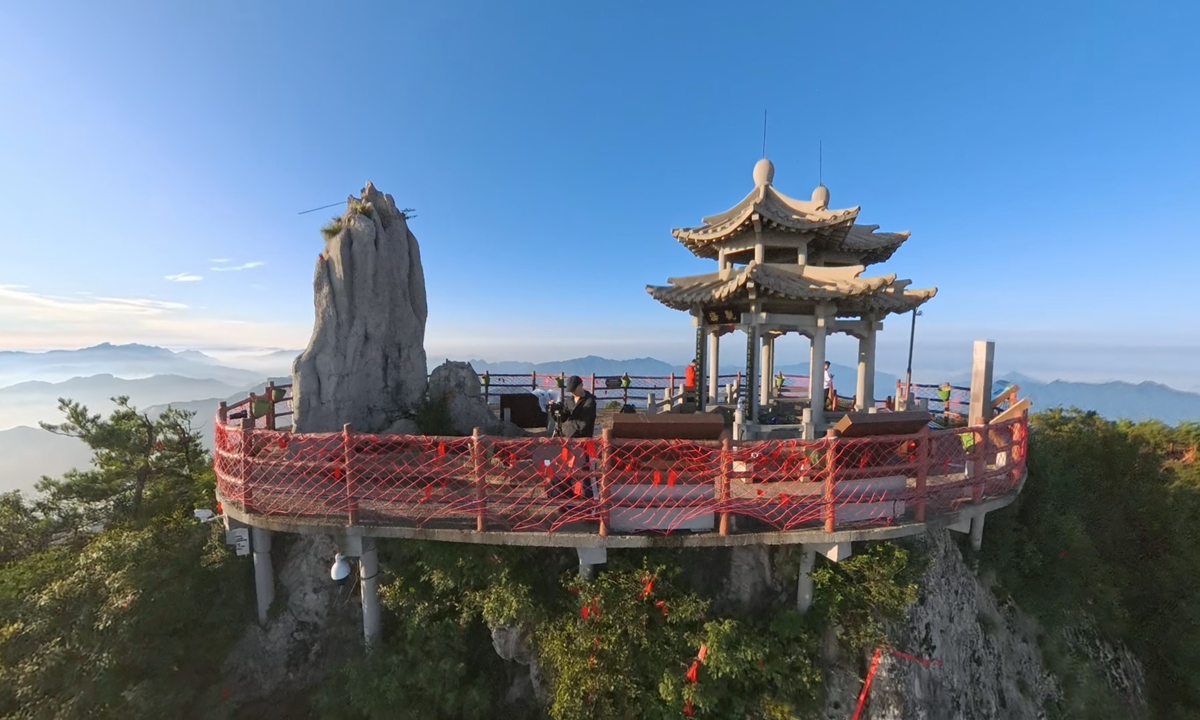
A sea of clouds rolls across Laojun Mountain in Luoyang, Central China's Henan Province, with golden-roofed temples emerging through the mist, on July 6, 2026. Photo: VCGFor 30 days, Li Sichen got up before sunrise on top of Laojun Mountain, camera in hand, chasing clouds across the peaks. Some mornings, the sea of clouds rolled in before breakfast; on others, he had to keep moving, checking one viewpoint after another in search of a patch of mist worth filming. By the time he got back to the foot of the mountain, the 22-year-old had spent a month watching the same landscape change by the hour - all for a job that had first caught the internet's attention for one simple reason: 60,000 yuan ($8,900) a month to "watch clouds."
It all began with Laojun Mountain's spectacular summer cloud season. In a recruitment notice issued in July, operator of the scenic spot said July and August offer some of the best chances to see seas of clouds there, and it wanted someone to stay on the mountain and record how the spectacle changed from day to day. The unusual job posting unexpectedly drew over 3,500 entries in about a week, with Li eventually emerging as the mountain's first "cloud sea observer."
Located in Luanchuan county of Luoyang, Central China's Henan Province, Laojun Mountain rises to 2,217 meters and is known for its dramatic peaks, seas of clouds and long history of Taoist culture, according to the mountain's official website.
But how does it feel like to work on top of the mountain, far away from online shopping, food delivery and party with friends?
An unconventional way of seeing "My days on the mountain quickly settled into a rhythm shaped partly by the clouds, and partly by the cafeteria," Li told the Global Times. He usually got up around 5 am to shoot the sunrise and clouds, had an early lunch as the cafeteria opens at 11 am, spent the afternoon exploring around the mountain, then rushed to cafeteria for dinner before heading back to the observation spots for sunset. The day often ended with editing footage until close to midnight.
"Sometimes there is nothing in front of you from one viewpoint, but after walking a little farther and changing the angle, a small sea of clouds jumps in front of my eyes."
Professional photographers usually seek higher vantage points for better views of seas of clouds, while Li sometimes headed down toward the mountainside. "That was something I really hadn't expected," Zhang Pengyuan, a manager at Laojun Mountain, told the Global Times.
"This was exactly why the scenic spot wanted eyes from outside to find the beauty of the mountain through a different angle," Zhang said.
What set Li apart, Zhang joked, was precisely that he was "not professional." Unable to calculate cloud heights or predict the perfect shooting conditions from weather forecast, Li relied on the simplest method: going out again and again to see what had changed. That sometimes led to compositions the scenic spot's own photographers had never considered. "What he recorded was closer to what an ordinary visitor could actually see," Zhang said.
Li had arrived on the mountain with little professional photography experience. Media reports said that before taking the job, he was not yet proficient with a drone, and his previous videos usually drew only a few hundred or a few thousand views. However, that changed almost overnight when his application video took off, eventually drawing tens of thousands of likes and helping him stand out from more than 3,500 applicants.
The "cloud observer" Li Sichen adjusts filming equipment at an attraction point on Laojun Mountain. Photo: Courtesy of Li Sichen
From visitors to storytellers Beyond Laojun Mountain, scenic spots across China have increasingly been inviting young people to take part in content creation, event planning and tourism promotion, often through unconventional jobs tailored to the language and habits of social media.
According to Southern Metropolis Daily, Shennong Valley National Forest Park in Central China's Hunan Province recently recruited 10 "wild men" to dress in animal costumes and interact with visitors in the forest.
The Dixin Valley Scenic Area in Hubei Province also drew more than 3,000 applicants for 12 summer trainee positions to play as NPCs, produce creative content, and work as photographer and tour guide for 10 days.
The idea goes beyond novelty. Scenic spots are increasingly turning to young creators who understand short videos, online trends and the interests of their peers. A tourism short-video contest in Jinhua, East China's Zhejiang Province held in 2025 featured university students presenting the city through vlogs, traditional-style costume transformations and AI-generated art - part of a broader effort to let young people help shape how destinations are seen and experienced.
Young travelers are increasingly drawn to experiences that are immersive, participatory and easy to share, reflecting a broader shift in China's tourism market from "standardized sightseeing" toward more personalized experiences, Zhang Lingyun, a professor and the executive editor-in-chief of the Tourism Tribune, told the Global Times.
As tourism offerings have expanded and competition has grown, travelers have more choices. Changing consumer preferences in China mean many young people now look beyond simply "seeing the beauty" to experiences that feel distinctive, personal and worth sharing on social media.
The internet and social media have accelerated this shift, Zhang said, adding that as "digital natives," Chinese young people are becoming increasingly fluent in short videos, social platforms and online interaction. By bringing young people directly into content production, scenic spots can move beyond simply guessing what tourists want through surveys, and learn from what they actually create and share.
Initiatives such as the "cloud sea observer" can help destinations rediscover themselves through a visitor's eyes while reaching younger audiences more effectively. The goal, Zhang noted, remains the same: better meeting tourists' needs, even as the tools, channels and participants have changed, he said.
On his final morning on Laojun Mountain, Li got up early once again to watch the sunrise. But this time, he lowered the camera.
"That was when I suddenly realized how beautiful the mountain really was," Li said. After 30 days of chasing clouds, searching for angles and turning each day into footage to share with other young Chinese in the online community, he was finally able to simply look.
When Li was really enjoying the last moments on the mountain, he - just like the line from comedy The Secret Life of Walter Mitty - "didn't like to have the distraction of the camera. Just wanted to stay in it."
。
BANGKOK -- The first group of Thai workers evacuated from Israel after the past few days’ bloody events in southern Israel and Gaza arrived Thursday in the Thai capital of Bangkok, greeted by anxious relatives and senior officials.Hamas militants stormed through a border fence Saturday and killed hundreds of Israelis in their homes, on the streets and at an outdoor music festival. The Israelis have responded with punishing airstrikes and preparations for a possible ground invasion. The conflict has claimed at least 2,600 lives on both sides, including some Southeast Asian workers living in Israel.The 41 Thais who returned home on a commercial flight of the Israeli airline El Al included two men wounded in the violence who had to use wheelchairs to exit the aircraft.Farm laborers from Thailand seek work in more developed countries where there is a shortage of semi-skilled labor — at wages considerably higher than they can earn at home.Tens of thousands of workers in Israel from nations including Thailand and the Philippines send their earnings home to support their families. That money also helps to fire up their native countries’ economies.But the appearance of Thais and Filipinos on the lists of dead, wounded and missing in the past few days is a reminder that foreign workers toil in peril of their lives.About 30,000 Thais are working in Israel, according to the Thai Foreign Ministry, and about 5,000 of them live in the southern area near the border with Gaza.One of them, Katchakorn Pudtason, said his employer at the farm where he worked initially herded all his workers into a bunker when Saturday's attacks took place, but after they left it for lunch they could still hear shooting. As they were being driven back to their workplace, Katchakorn heard more gunshots and felt something hit his knee, he said.“I thought it was a rock but it went through. So I hit the truck and told the driver to drive away,” he said. He added that he was one of four people in the vehicle who suffered injuries that day. He was one of the two returnees who had to use a wheelchair.Thailand's Cabinet ministers for labor, defense and foreign affairs were at Bangkok's international airport for the evacuees' arrival. The government has vowed to look after the evacuees' physical and mental well-being.Foreign Minister Parnpree Bahiddha-Nukara said 5,990 Thais have registered to be evacuated and officials are working around the clock to accommodate them.“We need a Plan B to take out as many people as possible,” said Defense Minister Suthin Klangsaeng. “We will use military aircraft to evacuate people from the high-risk area to a third country, such as (the United Arab Emirates).”The number of Thais affected by the tragedy stood out in lists of non-Israeli nationals affected by the violence: Thailand’s foreign ministry Thursday said 21 Thais are believed dead and 14 wounded. Sixteen were believed to have been taken hostage.Survivor Chatree Chasri left his home in northeastern Thailand in 2019 to work in Israel as an agricultural laborer to pay off debts and provide for his wife and two children back home in Nakhon Phanom. Foreign work is a common path for Thais from the country’s economically disadvantaged rural areas, especially the northeast.Working under a government-to-government agreement, the 38-year-old has been farming tomatoes and cauliflower for the past four years in the southern Israeli town of Mivtahim, less than 10 kilometers (6 miles) away from Israel’s border with Gaza.Despite the occasional shelling and rocket attacks that sent him running for cover, his life at the farm had been OK until Saturday, he said from Israel in a phone interview with The Associated Press. Now he says he wants to come home, and never go back to Israel.Chatree was shot several times in his hip shortly after Hamas launched its rocket attacks and shock ground offensive into southern Israel, killing hundreds of people and capturing more than 100 who were hauled back to Gaza as hostages.Chatree was using a toilet at the farm where he works with other foreign laborers when he suddenly heard gunshots.“The sounds came closer and bullets went through the wall of the toilet,” he said, recalling the moment he was hit. He then saw two gunmen making their way into the workers' living quarters and open fire, so the workers fled outside to hide.Vibhavadi Vannachai, a Thai expatriate who has lived in Israel for nearly two decades and is coordinating with Israeli authorities to help the Thai workers, fears the number of victims may rise.Vibhavadi, originally from Nong Bua Lamphu province in Thailand’s northeast, works as an interpreter in a legal office whose cases mostly involve resolving disputes between Thai workers and their employers.She said abuse and violations of their rights are common, with many bound by years-long contracts but cheated of their wages. Many are forced to work long hours and are beaten if they refuse. Some have to live in “quarters that are not fit for human beings,” she said.Vibhavadi helped find temporary accommodations for Chatree and Padoong Bootmo, a 26-year-old Thai worker shot on Saturday who said the potato and yam farm where he works in Yesha was raided twice by gunmen and then burned down. Padoong said in a phone interview he had been able to send 40,000 baht ($1,100) home each month. He might under the best of circumstances make less than half that doing the same job in Thailand, but he said he doesn’t want to stay in Israel anymore.The killing of at least two Filipino foreign workers underscored the threats also faced by those workers in Israel. About 30,000 Filipinos live and work in the country many as caregivers who look after the elderly, the ill and those with physical disabilities, according to the Philippines' foreign ministry. The huge income they send back home, which last year amounted to an all-time high of $36.14 billion, has helped keep the country’s fragile economy afloat.One of the two Filipinos killed Saturday was a caregiver who was shot with her employer inside their house by Hamas gunmen, according to the Philippines Embassy in Israel. The other was killed under still-unclear circumstances.At least three Filipinos remain missing, embassy officials have said.Still, Foreign Undersecretary Eduardo de Vega said Wednesday that no Filipino has asked to be repatriated from Israel. Jeremiah Supan, a 34-year-old Filipino caregiver in Israel, told The Associated Press in a telephone interview Wednesday that he made it clear to Philippines officials he did not want to return home. As the family breadwinner, he sends his earnings home to enable his 10-year-old son to remain in school and sustain other loved ones."The rocket firings continue” Supan said. “But if I leave, all that assistance that I send to my family back home will be lost.”___Gomez reported from Manila. Associated Press writer Grant Peck contributed.。
Current article:http://q5zz.tibiantasangnenti.buzz/list_f1fxkjk/4n5bav.html
Published on:06:18:45